- March 16, 2026

Firms that systematically track law firm KPIs across marketing, intake, and case management grow 40% faster than those relying on intuition and anecdotal evidence alone. Yet most managing partners still make budget decisions based on incomplete data, missing opportunities to convert leads into signed clients while competitors gain competitive advantage.
This performance gap isn’t accidental. The difference between scattered marketing efforts and predictable growth lies in implementing a focused KPI framework. You’ll discover which metrics actually drive signed clients, how to set realistic targets by practice area, and the governance cadence that keeps your team accountable to measurable outcomes.
Ready to transform your marketing spend into a predictable growth engine? Law Firm Fractional CMOs conducts comprehensive marketing audits that pinpoint exactly where your firm is losing potential clients and revenue.
Most managing partners make marketing decisions based on instinct, anecdotes, or the loudest voice in the room. This approach worked when competition was lighter, but today’s legal market demands precision. Understanding how do law firm KPIs support strategic decision-making transforms scattered efforts into a predictable growth engine that consistently outperforms competitors who still rely on guesswork.
When partners debate marketing spend without data, conversations become circular and unproductive. KPIs establish objective benchmarks that shift discussions from “I think this works” to “here’s what the numbers show.” According to the American Bar Association, firms that implement consistent KPI tracking see improved alignment between marketing investments and business outcomes. This shared language allows marketing teams, intake staff, and partners to collaborate around measurable goals rather than competing priorities.
The biggest ROI killers often hide between marketing spend and signed retainers. Consider a firm spending $10,000 monthly on Google Ads that celebrates 200 leads while missing that their 48-hour response time converts only 15% compared to the industry average of 35%. Firms focus heavily on cost-per-lead while ignoring response times that destroy conversion rates. Research from the Oklahoma Bar Association shows that responsiveness metrics directly impact conversion rates and reputation, with slow response times creating leaks that dwarf advertising costs. Mapping KPIs to each stage of the client journey, as detailed in proven intake optimization strategies, reveals where prospects drop off and why marketing dollars fail to convert into revenue.

Without structured review cadences, KPIs become vanity metrics that gather dust in forgotten dashboards. Clio’s benchmarks show that firms tracking utilization, realization, and collection rates consistently outperform those relying on revenue alone. A quarterly governance process ensures teams focus on metrics that drive signed retainers and realized fees, not website traffic or social media likes. This systematic approach to data-driven decision-making, as outlined in comprehensive marketing planning methodologies, creates accountability and enables rapid course corrections when performance drifts from targets.
Need help tracking the right metrics for your law firm’s growth?
The question of how do you set measurable KPIs for a law firm starts with your revenue targets. Begin with annual profit goals, then reverse-engineer the intake volume, conversion rates, and cost-per-signed-client targets needed to achieve those revenue goals. If you need 200 new cases at an average fee of $5,000, work backward through your retainer rate and contact rate to determine required lead volume. This approach ensures every KPI connects directly to business outcomes rather than activity-based metrics.
Once you’ve established these targets, effective KPI management requires SMART objectives with clear ownership and trigger thresholds for action. Assign each metric to a single accountable lead and review progress quarterly. Define specific escalation points, such as when speed-to-lead exceeds five minutes for two consecutive weeks. This creates a performance scorecard that transforms reactive management into proactive optimization, keeping your team focused on metrics that drive signed retainers.
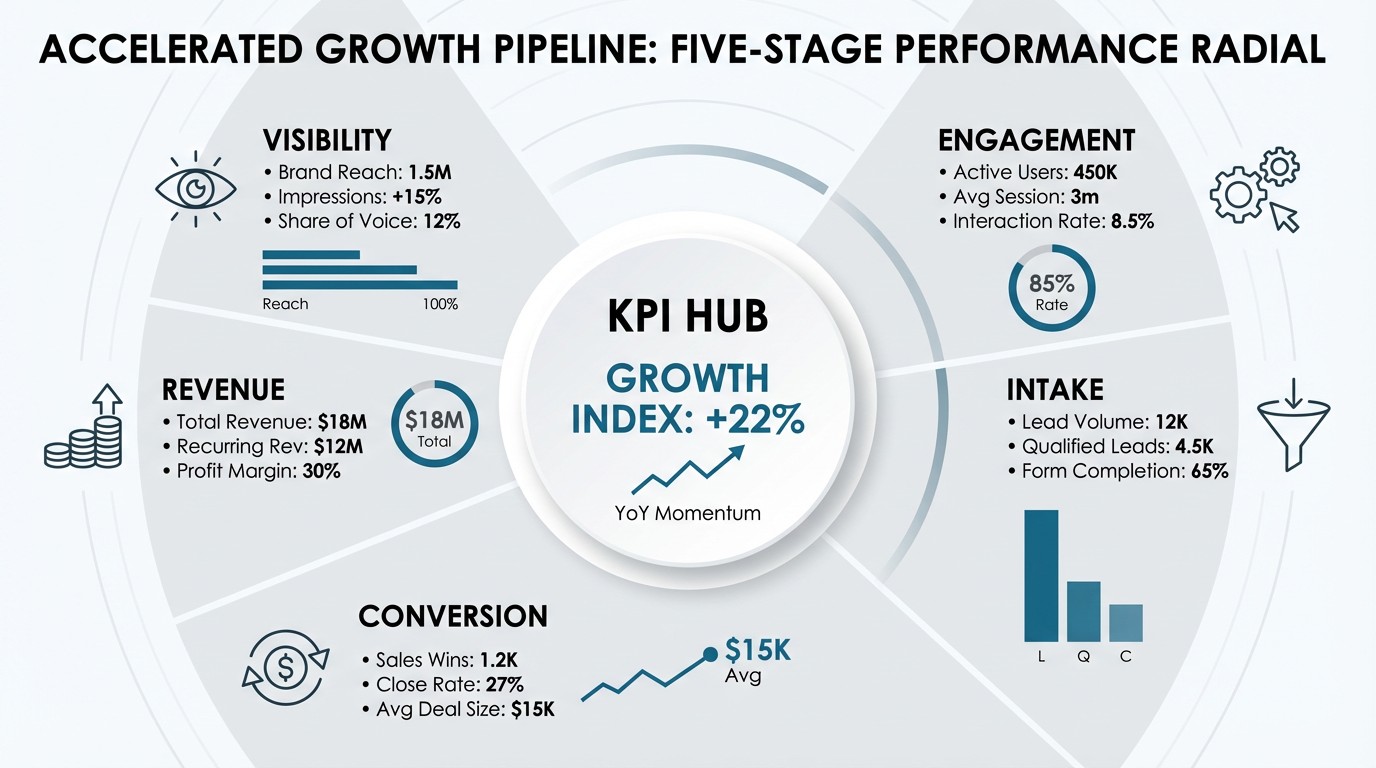
Disconnected metrics cost law firms thousands in wasted marketing spend and missed opportunities every month. Without a clear connection between marketing activities and signed retainers, managing partners make decisions based on incomplete data. A structured law firm KPI framework changes that by creating a clear path from marketing investment to business outcomes. The ABA recommends organizing measurements into categories that mirror your client journey, making it easier to spot where prospects drop off and where your team should focus improvements.
Most law firms track the wrong metrics, celebrating high website traffic and cheap cost-per-lead while missing conversion breakdowns that cost them cases. Smart managing partners reverse this approach by tracking backwards from revenue to identify the acquisition and intake metrics that predict signed retainers and answer which law firm KPIs drive client acquisition and retention.
Cost-per-lead creates false confidence. A $50 personal injury lead that never converts is exponentially more expensive than a $200 lead that signs a $15,000 retainer. Track cost-per-signed-client as your primary acquisition metric and optimize campaigns based on signed-client yield. This shift changes everything about budget allocation. Channels that generate cheap leads but poor conversion rates get cut, while higher-cost sources that deliver qualified prospects get scaled. A comprehensive marketing audit reveals these hidden conversion gaps across your current spend.
Once you’re tracking the right outcome metric, the next step is instrumenting your intake funnel. Harvard Business Review research shows companies responding to leads within five minutes are 100 times more likely to connect than those waiting 30 minutes. Track speed-to-lead, contact rate within 24 hours, qualification rate by source, and retainer rate by attorney. These metrics expose exactly where prospects leak out of your funnel. Most firms discover their intake process is costing them more than their advertising spend. Proper intake optimization can double your signed-client rate without increasing ad spend.
Establish clear performance thresholds for each marketing channel and practice area. If Google Ads drops below your target cost-per-signed-client for two consecutive weeks, reallocate that budget within 48 hours to better-performing channels. Create trigger points that remove emotion from budget decisions. When Facebook generates 40 leads but zero signed clients while referrals convert at 60%, the math is simple. This disciplined approach to channel optimization separates growing firms from those stuck in expensive lead-generation cycles.

Speed-to-lead is the most predictive law firm intake KPI for conversion success. Firms responding within five minutes consistently achieve higher contact rates than those waiting 30 minutes or longer. Track your contact rate within 24 hours with a target of 78% or higher, and monitor qualification rates by practice area since personal injury leads typically qualify at different rates than family law or estate planning prospects. Research on intake system optimization shows firms should measure these foundational metrics for 30 days to establish reliable baselines.
Beyond initial contact metrics, consult show rate and retainer rate by source reveal your intake team’s true effectiveness. Firms that implement systematic intake processes use scripted follow-ups and two-way SMS reminders to boost these conversion rates measurably. Enable call tracking and CRM stage timestamps to diagnose specific breakdown points—for example, if timestamps show a consistent three-day delay between initial contact and scheduling, you know the bottleneck is scheduling capacity, not lead quality. As detailed in our proven marketing approach, firms using these diagnostic tools identify and fix specific issues within 60-90 days.
Client retention KPIs law firm leaders should prioritize include net promoter score, review velocity, and referral rate. These metrics predict organic growth and reduce client acquisition costs over time. Industry benchmarks show legal practices average an NPS of 25, but top-performing firms with systematic client feedback programs achieve scores above 50. Track monthly review generation, and quarterly referral volume to identify trends before they impact revenue. These leading indicators give you 60-90 days advance notice of growth acceleration or decline.
Calculate lifetime value using realized fees, matter frequency, and referral contribution when applicable. BCG research recommends keeping LTV models simple and validating with historical data. Implement a systematic 33-day post-closure follow-up sequence for reviews and referrals. Assign ownership to specific team members and track completion rates in your CRM. Firms using structured intake processes report 40% higher referral rates within six months of case closure.
Most law firms struggle with a common question: how can law firms track marketing ROI with KPIs that actually drive growth decisions? The challenge isn’t just measuring leads or calls—it’s connecting every marketing dollar to signed clients and realized revenue. The solution lies in implementing multi-touch attribution, three-layer ROI reporting, and clear decisioning rules for channel optimization. Without this systematic approach, managing partners often scale the wrong channels or pause profitable ones based on incomplete data.
Multi-touch attribution tracks every touchpoint in a client’s journey, from first website visit to signed retainer. However, attribution models can create misleading insights if they’re not reconciled to actual outcomes. Your CRM should connect initial lead source through every interaction to final case signing and fee realization. This means tracking not just which Google Ad generated the lead, but whether that lead became a paying client six months later. Without this revenue reconciliation, even sophisticated attribution models can mislead you into scaling unprofitable channels while overlooking your most valuable lead sources.
Report channel performance at cost-per-lead, cost-per-qualification, and cost-per-signed-client to avoid misleading conclusions. For example, Facebook ads might deliver $50 leads while Google Ads cost $120 per lead—but if Facebook’s qualification rate is 15% versus Google’s 45%, the cost-per-qualified-lead reverses dramatically. Higher-cost channels often convert better through the full funnel, making them more profitable per signed client. A comprehensive marketing audit establishes baseline metrics for each layer, then tracks weekly performance against targets. This three-layer approach reveals where your funnel breaks down and which channels deserve more budget.
Create clear rules for scaling and pausing channels based on cost-per-signed-client performance, following proven governance frameworks for attribution management. Scale any channel beating your target by 20% or more within 48 hours—this threshold accounts for normal performance fluctuations while capturing genuine outperformers. Pause channels missing targets by 10% for two consecutive weeks to avoid knee-jerk reactions to temporary dips. This removes emotion from budget decisions and ensures resources flow to profitable channels quickly. For law firms specifically, these systematic rules prevent the common mistake of abandoning channels during seasonal slowdowns or doubling down on vanity metrics that don’t translate to sustainable growth.
Managing partners should use these benchmarks as diagnostic tools to identify performance gaps and set quarterly improvement targets. Start by measuring your current performance against baseline ranges, then establish aggressive targets that stretch your team’s capabilities while remaining achievable within 90-day improvement cycles.
|
Practice Area |
Metric |
Baseline Range |
Aggressive Target |
Notes/Assumptions |
Review Cadence
|
|
Personal Injury |
Contact Rate |
60%–75% |
78%–85% |
After-hours coverage and speed-to-lead under 5 minutes drive higher rates |
Weekly |
|
Personal Injury |
Retainer Rate |
25%–40% |
40%–50% |
Attorney availability for consultations within 24-48 hours improves conversion |
Weekly |
|
Personal Injury |
CPL |
$150–$300 |
$100–$200 |
Competitive markets require premium positioning and channel optimization |
Monthly |
|
Personal Injury |
CPSignedClient |
$800–$1,800 |
$600–$1,200 |
Varies by average case value and retainer payment options |
Monthly |
|
Family Law |
Contact Rate |
65%–80% |
80%–90% |
Emotional urgency creates higher initial response rates |
Weekly |
|
Family Law |
CPL |
$60–$150 |
$50–$100 |
Local bar advertising restrictions may limit channel options |
Monthly |
|
Family Law |
Retainer Rate |
35%–50% |
50%–65% |
Flexible payment plans and consultation quality drive conversion |
Bi-weekly |
|
Criminal Defense |
CPSignedClient |
$600–$1,500 |
$500–$1,000 |
Time-sensitive nature allows for premium pricing with fast response |
Monthly |
|
Criminal Defense |
Contact Rate |
70%–85% |
85%–95% |
Immediate legal jeopardy creates urgency for quick engagement |
Weekly |
|
Estate Planning |
Review Velocity (30 days) |
10–25 new reviews |
33+ new reviews |
New online reviews within 30 days of case closure via automated follow-up |
Monthly |
|
Estate Planning |
Referral Rate |
15%–25% |
30%–40% |
Percentage of new clients from existing client referrals; relationship-driven practice |
Quarterly |
When metrics fall below baseline ranges for two consecutive review periods, conduct a diagnostic audit to identify operational bottlenecks, staffing gaps, or channel performance issues. The ABA’s KPI methodology emphasizes that consistent measurement creates accountability and drives behavioral change across your team. Industry benchmarking studies show that firms tracking these metrics quarterly outperform those relying on annual reviews by 40% in signed client growth.
Need help building a clear marketing attribution system?
Building a unified reporting system gives you complete visibility into which marketing investments generate signed clients and revenue. The right technology stack eliminates guesswork and empowers data-driven growth decisions across your leadership team.
The Personal Injury Marketing Transformation case study demonstrates how implementing daily KPI dashboards enabled faster channel optimization and drove signed cases from 61 to 175 per month. According to the American Bar Association’s guidance on financial dashboards, successful law firm dashboards consolidate separate reports while maintaining role-specific views that empower each team member to take ownership of their metrics.
Implementation typically takes 60-90 days when following a proven approach that prioritizes quick wins while building long-term reporting infrastructure. Your dashboard becomes the foundation for predictable growth when it connects marketing spend directly to signed clients and realized revenue.
Managing partners consistently struggle with turning marketing investments into predictable growth and building accountability into their teams. These answers address the specific challenges managing partners face when building data-driven systems that deliver measurable results.

Tracking vanity metrics like website traffic or social media followers instead of revenue-driving indicators. Many firms also set KPIs without clear ownership or review cadence. Our proven approach establishes specific accountability for each metric and trigger thresholds that prompt immediate action when performance drops.
Focus on five core metrics: cost-per-signed-client, contact rate within 24 hours, retainer conversion rate, client lifetime value, and marketing ROI by channel. These metrics connect directly to revenue and reveal where your growth engine needs attention. The ABA identifies six categories of KPIs that successful firms track consistently.
Review intake and conversion metrics weekly, marketing channel performance monthly, and strategic KPIs quarterly. Weekly reviews catch problems before they impact revenue, while quarterly reviews align KPIs with business objectives. This cadence prevents small issues from becoming expensive problems that erode profitability.
Calculate ROI using signed clients and realized fees, not just leads or consultations. Track multi-touch attribution when possible. Always reconcile to actual revenue for accuracy. Thomson Reuters data shows successful firms focus on realization rates and worked rates as key profitability indicators.
Begin with a 60-day baseline period to establish current performance across your top three practice areas. Optimizing intake processes first typically increases signed case volume by 20-40% before any marketing spend increases. Set weekly review meetings and assign specific ownership for each metric from day one.
Tracking the right metrics transforms scattered marketing efforts into predictable revenue growth. The framework from visibility to revenue creates systems that consistently generate qualified retainers and measurable ROI.

However, most managing partners lack the diagnostic tools to identify which metrics drive results. The case studies from successful firms show how intake optimization and focused KPI tracking eliminate wasteful spend. As the American Bar Association confirms, structured measurement improves decision-making across all practice areas.
The next step is pinpointing where your current marketing investments are generating returns and where they’re falling short. Law Firm Fractional CMOs delivers comprehensive 60-day marketing audits that reveal quick wins, eliminate waste, and build your roadmap to sustainable growth.